



Insights
Where strategy loses force before it becomes execution.
Executive perspectives on the hidden work behind Strategy Execution.
Written for Managing Directors, Country Managers and leadership teams carrying enterprise mandates.
Built around the moments where ownership, decisions, alignment and execution begin to break down.
The MD Series
Short executive articles on the pressures, patterns and decisions that shape the work of Managing Directors.
Apply the Thinking to Your Business
Want to see how SV would read your execution challenge?
Before any deeper engagement, SV can prepare a complimentary Execution Blueprint Teaser: a tailored first hypothesis of what your mandate may require before it can become executable.
.jpeg)
The MD Series · Pain 01
Politics
How to solve internal politics without becoming part of it.
Politics is not a people problem. It is what grows in the space where clarity is missing.
Internal politics rarely starts because people want a political organisation.
More often, it starts because the business has left too much room for interpretation. When priorities are unclear, people protect their own version of what matters. When ownership is not visible, influence starts to replace accountability. When decisions happen in private before they happen in the room, the organisation quickly learns where the real power sits.
For a Managing Director, the challenge is not to pretend politics does not exist. Informal influence exists in every leadership team. Understanding it is part of the role.
The real work is to make politics less useful.
That begins by publishing the work clearly enough for rumours to lose strength. Priorities need to be visible. Owners need to be named. Decision routes need to be understood. Standards need to apply even when the person involved is senior, influential or commercially valuable.
Neutrality also needs to be understood properly. Neutrality is not silence. If the Managing Director avoids the issue, the strongest informal system wins. If the Managing Director takes sides, credibility is lost. The move is to referee the rules, not the players.
Politics survives when people can win through private goals, unclear ownership and silent influence. It loses oxygen when the organisation can see what matters, who owns it, how decisions will be made and which behaviours will not be rewarded.
The Managing Directors who stay clean are not the ones who avoid the game. They are the ones who change what winning means.
Where does politics still survive because the business has not made the rules visible enough?
See the execution pattern in your own business.
SV can prepare a complimentary Execution Blueprint Teaser: a tailored first hypothesis of what your mandate may require before it can become executable.
Ask for your Blueprint Teaser →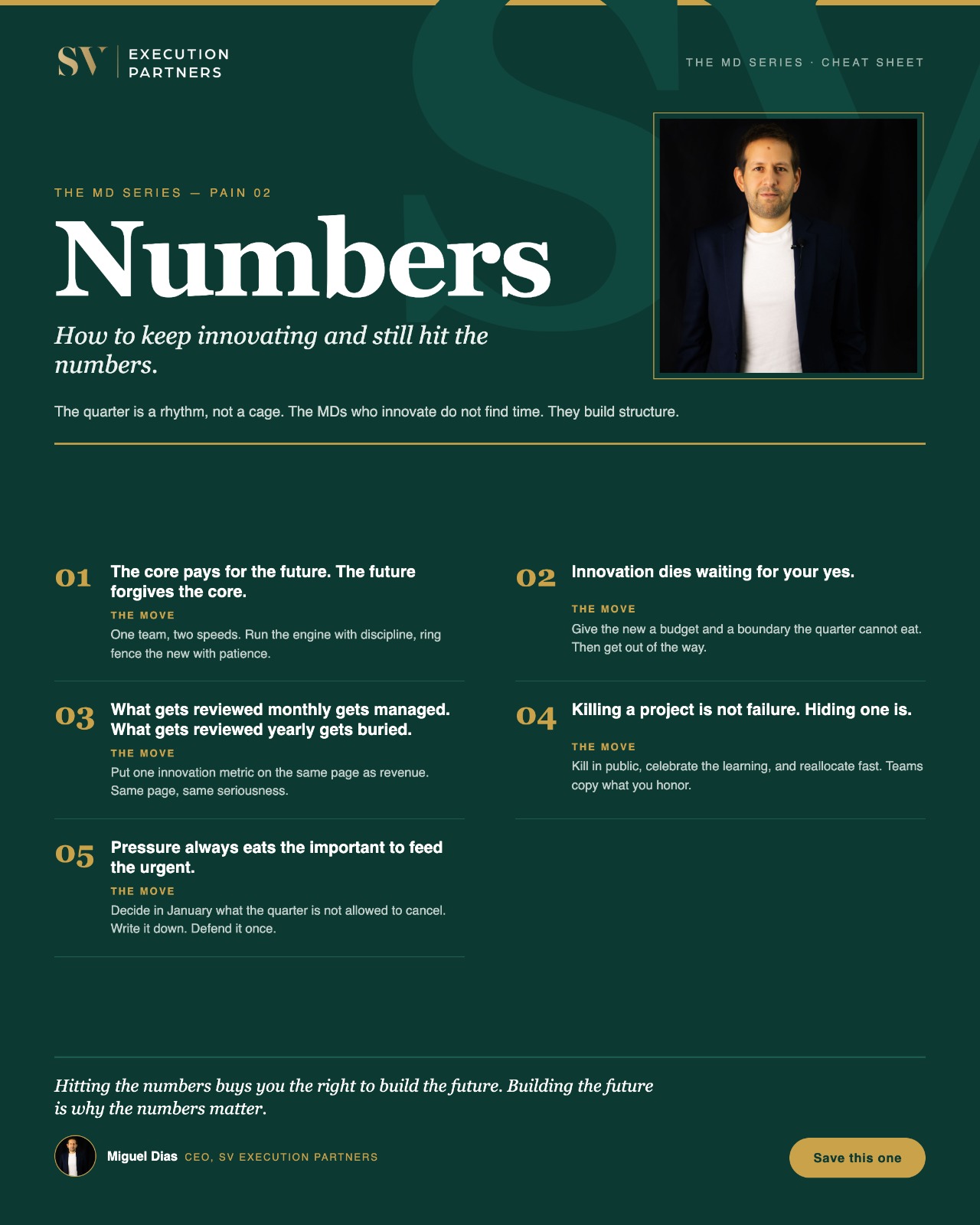
The MD Series · Pain 02
Numbers
How to keep innovating and still hit the numbers.
The quarter is a rhythm, not a cage. Managing Directors who keep innovating do not wait for more time. They create a structure that protects both today's performance and tomorrow's growth.
Every Managing Director faces the same tension. The core business needs discipline, predictability and constant attention because it carries the revenue, the clients and the commitments that already exist. At the same time, the company needs to explore new offers, markets, technologies and operating models before the current engine begins to lose relevance.
When both compete inside the same rhythm, the core usually wins. Its deadlines are closer, its problems are louder and its results appear immediately in the numbers. Innovation is pushed into the space left over after the quarter has taken everything it needs, which usually means that meaningful progress depends on spare time, personal persistence and repeated approval from the Managing Director.
The answer begins with one team operating at two different speeds. The core continues to run with clear targets, strong accountability and operational discipline. New initiatives receive enough protection to be tested without being judged by the same expectations as an established business. The core funds the future, while the future ensures that the core can continue to evolve.
This protection needs to be structural. An innovation project that must wait for the Managing Director's approval at every stage will move at the speed of their availability. A defined budget, clear decision boundaries and agreed escalation points allow the team to advance without turning every experiment into another item waiting in the leadership queue. Once those conditions exist, the Managing Director can step back without losing control.
The review rhythm matters just as much as the budget. What appears in the monthly operating conversation receives attention, resources and management time. What is discussed only during an annual strategy review gradually disappears beneath commercial pressure. Innovation therefore needs at least one visible metric alongside revenue, margin, pipeline and delivery. That metric might track customer validation, completed experiments, learning milestones or the time required to reach a decision. Its purpose is to make progress visible before it becomes financial performance.
Visibility also makes it easier to stop work that is no longer justified. Projects often survive because teams fear that closing them will be interpreted as failure. The result is hidden underperformance, delayed decisions and resources trapped in initiatives that nobody genuinely believes in. When a project is closed openly, its learning is documented and its resources are quickly reassigned, the organisation learns that disciplined experimentation includes knowing when to stop.
The final risk is the pressure of the quarter itself. Urgent work will always make a convincing case for taking people, budget and attention away from longer-term priorities. The Managing Director therefore needs to decide in advance which future-facing commitments the quarter is not allowed to consume. Once those commitments are written down, resourced and built into the operating rhythm, they no longer need to be renegotiated every time pressure rises.
Hitting the numbers gives the organisation the capacity to build its future. Building that future is what keeps the numbers meaningful beyond the current quarter.
Where is innovation still dependent on spare time, repeated permission or budget left over after the core has taken what it needs?
See the execution pattern in your own business.
SV can prepare a complimentary Execution Blueprint Teaser: a tailored first hypothesis of what your mandate may require before it can become executable.
Ask for your Blueprint Teaser →.jpeg)
The MD Series · Pain 03
CEO
How to grow from MD to global CEO.
Nobody promotes you for working harder. They promote you for what works without you.
The transition from Managing Director to a broader CEO role is not only a question of performance.
Strong results matter, but they are not enough. At a certain level, the question changes. The organisation is no longer only asking whether you can deliver. It is asking whether the machine you built can keep delivering when you are not in every decision, every escalation and every critical conversation.
That is why the best promotion case is rarely the busiest leader in the room. It is the clearest operating system.
A Managing Director who wants to grow into a wider role needs to make the business legible beyond their own effort. The group needs to see what the market has taught the company, how the unit creates results, where the next wave of growth sits and why the operating model can be trusted without constant personal intervention.
That means documenting more than outcomes. It means documenting the pattern behind the outcomes. What decisions mattered? What did the market reveal? Which rhythms made execution predictable? Which owners can now carry the work?
Succession is also part of the case. A strong number two is not a threat. A visible successor is an exit ticket. If nobody can take your seat, the business may value you too much to move you.
This is where many talented Managing Directors get trapped. They become essential to the current role and therefore less movable into the next one.
The work is to build a unit the group can quote, learn from and trust. Results open the conversation. The machine earns the promotion.
The next role is never given to the busiest person in the room. It is given to the clearest.
What would still stop your business from working if you were no longer in the room?
See the execution pattern in your own business.
SV can prepare a complimentary Execution Blueprint Teaser: a tailored first hypothesis of what your mandate may require before it can become executable.
Ask for your Blueprint Teaser →.jpeg)
The MD Series · Pain 04
HQ
How to talk to HQ while defending local needs.
HQ does not resist local needs. HQ resists surprises, noise and untranslated reality.
Local leaders often feel that headquarters does not fully understand their market.
Sometimes they are right. But being right is not enough. If the local reality arrives as frustration, exception or complaint, it is easy for HQ to read it as noise rather than information.
The strongest local defence is translation.
A Managing Director needs to convert local reality into the metrics, risks and trade-offs the group already trusts. The market may be different, but the argument still needs to travel in a language that can survive a board meeting.
This changes the conversation. Instead of asking HQ to understand the market emotionally, the local leader shows what the market is teaching the company. Instead of bringing a problem alone, they bring options, implications and a recommendation. Instead of asking for sympathy, they make the decision easier to take.
Trust is also built over time. A local unit that delivers what it promised for several quarters earns a different kind of attention when it asks for an exception. A market that surprises HQ repeatedly loses that privilege, even when the reasons are legitimate.
Small commitments matter. Every HQ conversation should end with clarity on who does what by when. Then it should be sent in writing. This is not bureaucracy. It is how confidence is built across distance.
The goal is not to become the subsidiary that explains itself best when things go wrong. The goal is to become the subsidiary the group learns from.
The strongest local defence is a track record HQ can quote in its own board meetings.
What local reality still needs to be translated into a language HQ can act on?
See the execution pattern in your own business.
SV can prepare a complimentary Execution Blueprint Teaser: a tailored first hypothesis of what your mandate may require before it can become executable.
Ask for your Blueprint Teaser →.jpeg)
The MD Series · Pain 05
Time
How to win time and have a life as an MD.
Your calendar is not a time problem. It is a mirror of your ownership model.
Most Managing Directors do not lose time in one dramatic place.
They lose it through a thousand small returns. Decisions come back for approval. Tasks come back half-owned. Meetings multiply because the team cannot recite the same priorities. Issues rise because nobody is sure where authority begins or ends.
The calendar becomes the visible symptom of the operating model.
Every decision only the MD can make is a bottleneck the organisation has learned to use. Some decisions genuinely require executive judgement. Many others reach the top because ownership is not strong enough, outcomes are not clear enough or the team has been trained to wait for approval.
Winning time is not about becoming less available in a superficial way. It is about redesigning what needs to reach the MD in the first place.
That starts by delegating outcomes, not tasks. Tasks come back for approval. Outcomes come back with evidence, decisions and next moves. It also means making priorities simple enough for the team to repeat without interpretation. One page of objectives can beat forty hours of meetings if it gives people enough clarity to act.
Availability also has a cost. A leader who is always reachable may believe they are being supportive, but constant availability can teach the team to stop deciding. Protected time is not a luxury. It is a leadership signal.
The goal was never a fuller calendar. It was a company that grows while the Managing Director is at dinner.
Which recurring decision would disappear from your calendar if ownership were clearer?
See the execution pattern in your own business.
SV can prepare a complimentary Execution Blueprint Teaser: a tailored first hypothesis of what your mandate may require before it can become executable.
Ask for your Blueprint Teaser →.jpeg)
The MD Series · Pain 06
Lonely
It is lonely at the top. It does not have to be.
Nobody warns you: the higher you go, the fewer people you can think out loud with.
Senior leadership can become lonely for very practical reasons.
Everything the Managing Director says can be heard as a decision. A doubt can become a signal. A question can create movement before the thought is ready. A concern shared too early can travel faster than the context around it.
So leaders learn to speak in conclusions.
They report upward with confidence, protect the team from uncertainty, stay composed in the room and carry more of the unresolved thinking privately. Over time, the armour works so well that fewer people ask how they are.
The danger is that isolation can start to look like strength.
It is not. Isolation is unmanaged risk. A leader who has no place to think in drafts is more likely to make expensive decisions alone, delay necessary conversations or use home as the only pressure valve for work the business should help carry.
The answer is not to turn the leadership team into a therapy room. The role still requires judgement, containment and discipline. But every senior operator needs an outside circle: a small number of peers, mentors, coaches or trusted advisors who owe them nothing politically and can hear the unfinished version of the thought.
There should be a place where questions are allowed and answers are optional.
Success can make leadership quieter. Fewer people relate, so the leader shares less. That silence may feel protective, but it also narrows perspective at the exact moment the decisions become more consequential.
The role is lonely by design. Staying lonely is a choice the best Managing Directors learned not to make.
Where do you currently have permission to think before you decide?
See the execution pattern in your own business.
SV can prepare a complimentary Execution Blueprint Teaser: a tailored first hypothesis of what your mandate may require before it can become executable.
Ask for your Blueprint Teaser →.jpeg)
The MD Series · Pain 07
Change
How to lead a transformation people actually follow.
Transformation rarely fails in the strategy. It fails in the messy middle, where belief runs out before the results arrive.
Most people do not resist change because they are difficult.
They resist what the change asks them to lose.
A new strategy may look logical from the top. It may be commercially necessary, strategically sound and well presented. But inside the organisation, change is rarely experienced as an abstract improvement. It is experienced as a shift in status, habits, confidence, routines, power, expertise or identity.
That is why transformation cannot be led only through the future it promises. It also has to name what people are being asked to leave behind.
For a Managing Director, this is one of the hardest parts of the role. The business needs movement, but the organisation needs meaning. If people cannot understand what is changing, why it matters and what will still be protected, they will interpret the transformation through what they fear losing.
This is also why a transformation without a concrete scene becomes dangerous.
If the future is described only in strategic language, people cannot walk towards it. They need to picture what will be different in the work itself. What decisions will change? What will customers experience differently? What will the leadership team stop tolerating? What will the organisation be able to do six months from now that it cannot do today?
Without that scene, transformation becomes reorganisation. People see movement, but not progress.
The old system will also defend itself. Not always loudly. Sometimes through delay, quiet scepticism, stalled hiring, unclear ownership or the familiar "not yet". That resistance should not surprise the leadership team. It should be expected and designed for.
Momentum matters here.
A visible win in the first 90 days can do more than another all-hands presentation. People do not need proof that everything is solved. They need proof that the change is real, that the direction is serious and that the organisation can move without waiting for perfect certainty.
The Managing Director cannot delegate belief. Structure can be handed down, but conviction cannot. If the leader stops explaining why the change matters before the new system has earned trust, the transformation starts to lose force.
Strategy sets the destination. Transformation is won or lost in how you carry people the distance.
What part of the change are people resisting because the loss has not been named clearly enough?
See the execution pattern in your own business.
SV can prepare a complimentary Execution Blueprint Teaser: a tailored first hypothesis of what your mandate may require before it can become executable.
Ask for your Blueprint Teaser →.jpeg)
The MD Series · Pain 08
Alignment
How to turn a room full of nods into ownership that lasts.
Everyone left the last offsite aligned. By week six, priorities are crossing again. Alignment is not an event. It is a rhythm.
Alignment often feels strongest in the room where it is created.
People nod. The direction makes sense. The priorities feel clear. The team leaves the offsite with energy and the belief that everyone is finally on the same page.
Then the business starts moving again.
Functions return to their own pressures. Customers create exceptions. HQ asks new questions. Urgent work competes with strategic work. By week six, priorities begin to cross and the alignment that felt obvious in the room starts to decay.
This is not because the offsite failed. It is because alignment was treated as an event when it needed to become a rhythm.
Real alignment is not agreement. It is repeated ownership.
The first test is whether people can disagree clearly before they commit. Compliance stalls the moment the Managing Director leaves the room. A silent yes is not alignment. An objection said out loud is worth more than ten polite nods because it reveals what the plan needs to survive.
The second test is ownership. Shared responsibility quietly becomes no one's responsibility. Every priority needs a name. "The team owns it" may sound collaborative, but it often hides the absence of a single person accountable for moving the work.
The third test is cadence. Alignment decays when it is not revisited. One clear page, reviewed weekly, can do more for execution than one impressive offsite remembered fondly. Priorities need to be ranked, decisions need to be made and ownership needs to be re-earned through rhythm.
A cleaner plan is not always the strongest plan. The plan people helped build is the plan they are more likely to defend. Ownership is created in the drafting, not in the reveal.
You do not need a team that agrees with you. You need a team that owns the same three things on Monday.
Where is your team aligned in conversation but not yet aligned in ownership?
See the execution pattern in your own business.
SV can prepare a complimentary Execution Blueprint Teaser: a tailored first hypothesis of what your mandate may require before it can become executable.
Ask for your Blueprint Teaser →