Turn group strategy into local execution and the mandate you carry into the business you intend to be known for.

SV works with Enterprise Managing Directors and Business Unit Leaders to create clear priorities, accountable ownership and an execution rhythm their leadership teams can run. We start with the future business you intend to build, work backwards to Monday, and stay in the room until the number lands.

Mike Dias in a working session

We are your STRATEGY EXECUTION PARTNER.

Your team becomes autonomous, and execution continues long after we step out.

For more than 20 years, CEOs and Enterprise Leaders have trusted us to implement execution systems that survive leadership changes, market cycles and growth phases. Driving Strategy Execution in Iberia and the Nordics.


airWallet
ForceManager
Webtec
Bayer
Leapwork
24Slides
Zensai
Envita

The Enterprise Execution Gap

The gap between group strategy and local execution is carried by the Managing Director.

Group priorities enter a business already balancing local targets, functional agendas and operational commitments. Authority, resources and decisions are distributed across the organisation, while accountability for the result remains with one leader.

When local translation is incomplete, dependencies stay unresolved and functions move to different agendas, progress depends on the Managing Director reconnecting the business, unlocking decisions and restoring momentum.

The cost reaches beyond delayed results. It consumes strategic attention, keeps the leadership team dependent on escalation and makes the mandate the leader was appointed to deliver harder to prove.

Group Strategy

The direction is clear at headquarters.

Local Translation

Priorities enter an existing operating reality.

Functional Agendas

Resources, incentives and commitments compete.

Unresolved Dependencies

Ownership exists without enough authority to act.

Managing Director

Decisions, blockers and momentum return to one person.

The Number

Progress slows and credible evidence arrives late.

The execution system shapes three outcomes at once: the number the business delivers, the team the leader builds and the mandate they become known for.

See how The Execution Blueprint closes the gap →
SV working session with a leadership team

Who We Work With

The moments that define the business also define the leader carrying the mandate.

SV works with Enterprise Managing Directors and Business Unit Leaders when a new appointment, group priority or visible transformation raises the stakes of execution. At these moments, the business result, the strength of the leadership team and the leader's professional reputation are being built at the same time.

01

New to the role

Create early movement, build credibility, assess the leadership team and establish an execution rhythm before inherited complexity becomes the operating norm.

02

Carrying a new group mandate

Turn strategic direction into local priorities, resource choices, decision rights and business-linked outcomes that the leadership team can own.

03

Leading a visible transformation

Coordinate growth, AI, integration, efficiency or portfolio change across functions that do not share the same priorities, authority or incentives.

04

Execution under pressure

Restore movement when targets are missed, headquarters needs credible evidence, or existing OKRs and reviews report activity without changing decisions.

Different moments. The same requirement: a leadership team capable of carrying the mandate from strategy to number.

Find the right starting point →

The Mandate Behind the Number

Your mandate is measured in numbers. Your career is shaped by what the business becomes under your leadership.

A strategic mandate carries more than a target. It asks you to translate group direction into a stronger business, build a leadership team capable of sustaining it and create progress that headquarters can trust.

SV begins with a concrete future scene: the moment when the business result is visible, the team operates with greater ownership and your contribution to the organisation is unmistakable.

From there, we work backwards to the conditions, decisions and commitments that make that future executable.

The number proves the result. The business you leave behind proves the mandate.

Discover The Execution Blueprint →
2036
the entry conditions
fall into place, one
by one, in reverse
Monday

The Execution Blueprint

From your 2036 scene, back to Monday.

The Execution Blueprint turns a strategic mandate into a sequence the leadership team can act on. We begin with the future already made visible, then work backwards through every condition that must become true. Each condition receives an owner, a date and a clear view of the risk that could stop it. The process lands on the first decision, conversation or commitment that proves the future has already begun.

The Scene → The Entry Conditions → Monday

One line of sight from the mandate you carry to the next move the business must make.

Explore The Execution Blueprint →
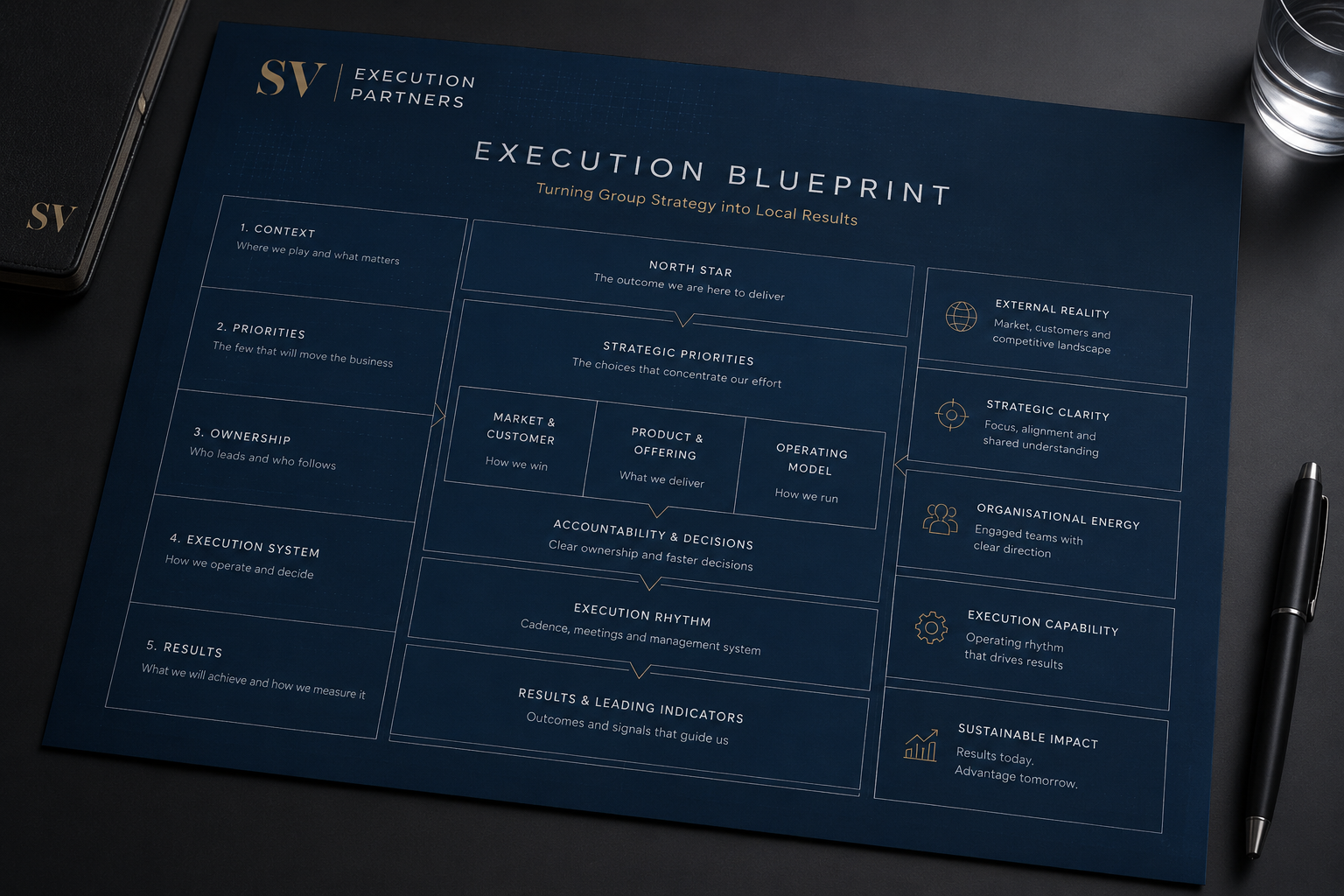

The Execution Blueprint — from future scene to Monday

How We Work

One ladder. Four steps. Each one moves the mandate closer to the number.

The work begins with the Managing Director, expands to the leadership team and then moves into the operating rhythm of the business. Each step produces a concrete output, builds on the one before it and leaves the organisation more capable of sustaining execution.

01

Managing Director · One Working Morning

Managing Director Execution Blueprint

One working morning to define the future scene, map the entry conditions and identify the first Monday commitment. The result is a one-page Blueprint delivered within 48 hours.

02

Leadership Team · One Full Day

Leadership Team Execution Blueprint

One full day with the leadership team to surface different interpretations of the future, resolve the collisions and assign an owner and date to every critical condition.

03

90-Day Execution Cycle

Execution Cadence

A 90-day cycle that translates the year's entry conditions into business-linked OKRs, clear ownership and a fortnightly rhythm for decisions, progress and blockers.

04

Quarterly Continuity

Quarterly Execution Partnership

SV remains in the room from cycle to cycle, preserving the discipline, adapting the system and transferring the rhythm until the leadership team can run it independently.

Define the future. Align the team. Implement the rhythm. Transfer the system.

Explore how we work →

What Changes

The strategy reaches the number. The leadership team learns to carry the distance.

The Execution Blueprint creates a shared line of sight from the group mandate to the local business result. Priorities become fewer and sharper, authority moves closer to the decisions that matter, and dependencies surface early enough to be resolved before they return to the Managing Director. The leader remains accountable and in control, while the organisation becomes increasingly capable of sustaining execution when their attention moves elsewhere.

The business gains

Focus

A limited number of shared outcomes connected to the P&L.

The team gains

Authority

Owners can make decisions and resolve dependencies before escalation.

The leader gains

Altitude

The Managing Director can lead the mandate without becoming the operating system behind every priority.

We close the gap between the strategy and the number by making execution a capability of the organisation.

Why SV Execution Partners

We do not leave you with a framework. We stay until execution is working in the business.

Every engagement is senior-led, built around a defined business priority and connected to a measurable result. SV works inside the leadership team's real operating rhythm to clarify ownership, resolve the decisions that hold execution back and turn the Blueprint into a system the organisation can sustain.

The objective is clear from the beginning: implement the system, prove the movement and transfer the rhythm to the team.

Miguel DiasFounder, SV Execution Partners

Define the scope. Implement the system. Transfer the rhythm.

Schedule a meeting →

Miguel Dias
20+

Years alongside CEOs and leadership teams

18 months

For one client to reach its three-year vision after building an autonomous leadership team around the Blueprint cadence

BAYER · ZENSAI · LEAPWORK · FORCEMANAGER (SAGE)

YEAR 3
brought into
YEAR 1 + YEAR 2

Selected Case Study · Zensai

A three-year vision moved into Year 1 and Year 2.

When the new CEO joined, the vision was clear. What was missing was an execution system capable of turning it into predictable weekly movement across an international leadership team.

SV built the operating rhythm from the ground up, connecting the three-year direction to one-year priorities, 90-day outcomes and weekly execution. Ownership moved from the CEO to the leadership team, while Denmark, the US, Poland and Australia began working through one shared cadence.

Year-3 outcomes achieved during Year 1 and Year 2.

3+ years laterThe execution rhythm was still running.
One global cadenceDenmark, the US, Poland and Australia operating through the same weekly rhythm.
The clarity of the vision, priorities and progress also supported a successful VC raise. Read the Zensai case study →

Proven impact across global leadership teams.

For more than 20 years, CEOs, Enterprise Leaders and leadership teams have trusted us to install execution systems that survive leadership changes, market cycles and rapid growth — long after we step out. Here are some of their testimonials.

Insights & Execution Library

Thinking for the decisions ahead. Tools for the work that follows.

Explore SV's latest thinking on enterprise strategy execution or access practical resources designed to help leadership teams turn priorities into movement.

Insights

Strategy execution, examined from inside the leadership room.

Articles, enterprise cases and perspectives on the decisions, ownership and operating rhythms that move strategy forward.

Explore Insights →

Execution Library

Practical resources for turning strategy into execution.

Access tools, templates, assessments and working packs developed to help leaders clarify priorities, strengthen ownership and improve the execution rhythm.

Explore the Execution Library →

The Next Step

Let us read the strategy before we meet.

Tell us which company, market or business unit you lead. SV will prepare a first Execution Blueprint hypothesis using public information, connecting the group direction to the conditions, ownership and first commitments that could move it forward locally. You will see the method applied to your business from the first conversation, rather than presented through a generic framework.

[ form ]